

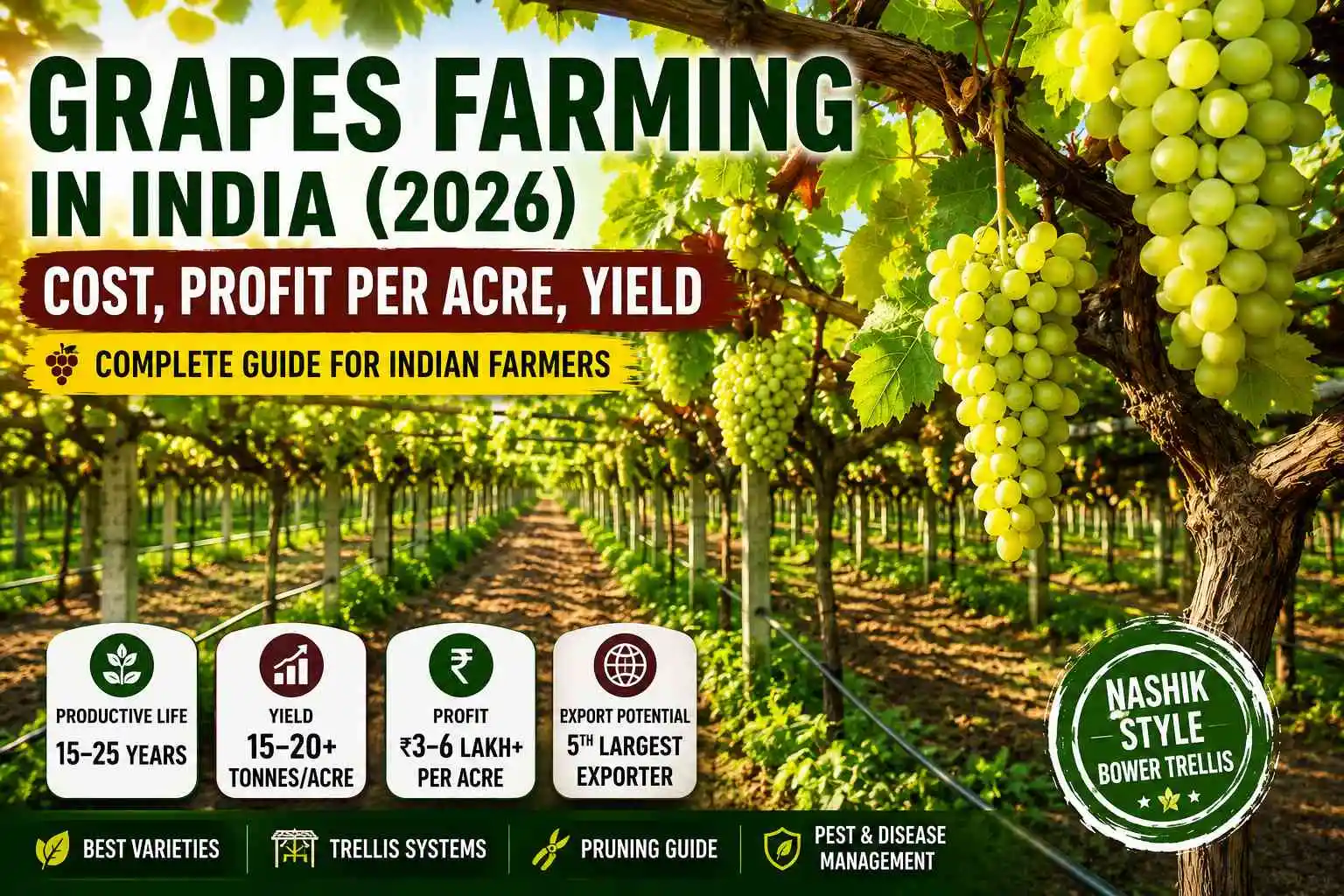

Grapes Farming in India (2026): Cost, Profit Per Acre, Yield
Grapes farming is turning into one of the most dependable ways for Indian farmers to build long-term income from their land. Plant it once, and a healthy vineyard keeps giving you fruit for 15 to 20 years or more. That single fact explains why lakhs of hectares across Maharashtra, Karnataka, Andhra Pradesh, and Tamil Nadu are now under grape cultivation, and why more farmers ask about it every season.
This guide covers everything worth knowing before you plant your first vine — soil and climate needs, the varieties that actually sell well, pruning, pests, and real cost and profit numbers in rupees. No exaggerated promises, just what a serious grower needs to plan properly.
Quick facts about grapes farming in India
| Point | Details |
|---|---|
| Top producing state | Maharashtra (over 70% of national output) |
| Grape capital of India | Nashik district |
| Time to first commercial harvest | 2nd–3rd year after planting |
| Productive life of a vineyard | 15–25 years |
| National average yield | Around 9 tonnes/acre (NHB data) |
| Well-managed vineyard yield | 15–20+ tonnes/acre |
| India’s global export rank | 5th largest fresh grape exporter |
Why Grapes Farming Makes Sense for Indian Farmers
Compare grapes with a regular cereal crop and the difference is obvious. Wheat or paddy earns a modest return per acre after a full season of work. A mature grape vineyard, on the other hand, can bring in several lakh rupees per acre every single year, from one initial planting.
A few reasons grapes farming keeps pulling in new growers:
- It’s a perennial crop — plant once and harvest for 15 to 25 years
- India is the world’s 5th largest exporter of fresh grapes, so a genuine export market exists, not just talk
- Grapes fetch a far better price per kilo than most fruits and almost all vegetables
- Government schemes cover a meaningful share of the setup cost
- Vegetables can be grown between the rows in the first year or two for extra cash flow while the vines establish
The flip side is that grapes farming is not a sow-it-and-forget crop. It demands attention — correct pruning twice a year across most of Peninsular India, a disciplined spray schedule, and careful water control. Growers who treat it as a serious, skill-based business earn well. Those who treat it casually struggle with disease and poor bunches.
Climate and Soil Needed for Grapes Farming
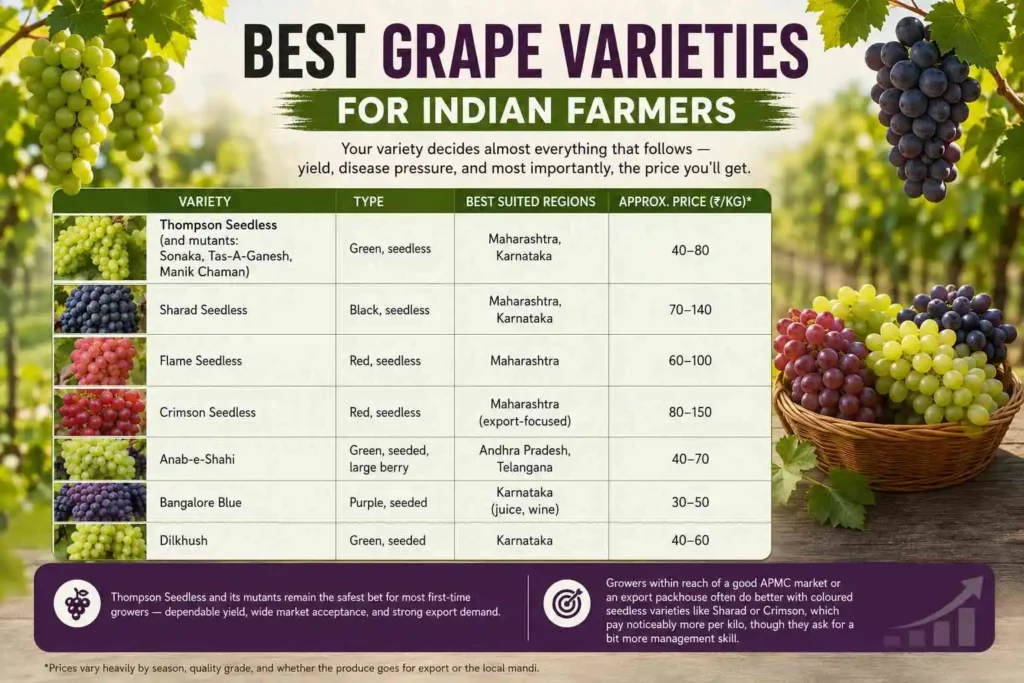
Grapes are a warm, dry-climate crop by nature. Rain and humidity around flowering and fruit-ripening time are the real enemy — that’s exactly when fungal disease takes hold.
What grapevines actually need:
- Temperature: 15°C to 40°C, with a short cool spell in winter so the vine can rest
- Rainfall: Areas with less than 900 mm a year suit grapes best; what matters more than total rainfall is the number of rainy days, especially near flowering
- Altitude: Grapes do well even above 250 metres — Nashik itself sits at this kind of elevation
- Soil: Deep, well-drained loamy soil with a pH of 6.5 to 7.5
Something that surprises new growers: grapevines don’t want extremely rich soil. Over-fertile land pushes the vine into producing more leaves and shoots than fruit. Moderate fertility with excellent drainage beats “the richest soil in the village” almost every time.
Best Grape Varieties for Indian Farmers
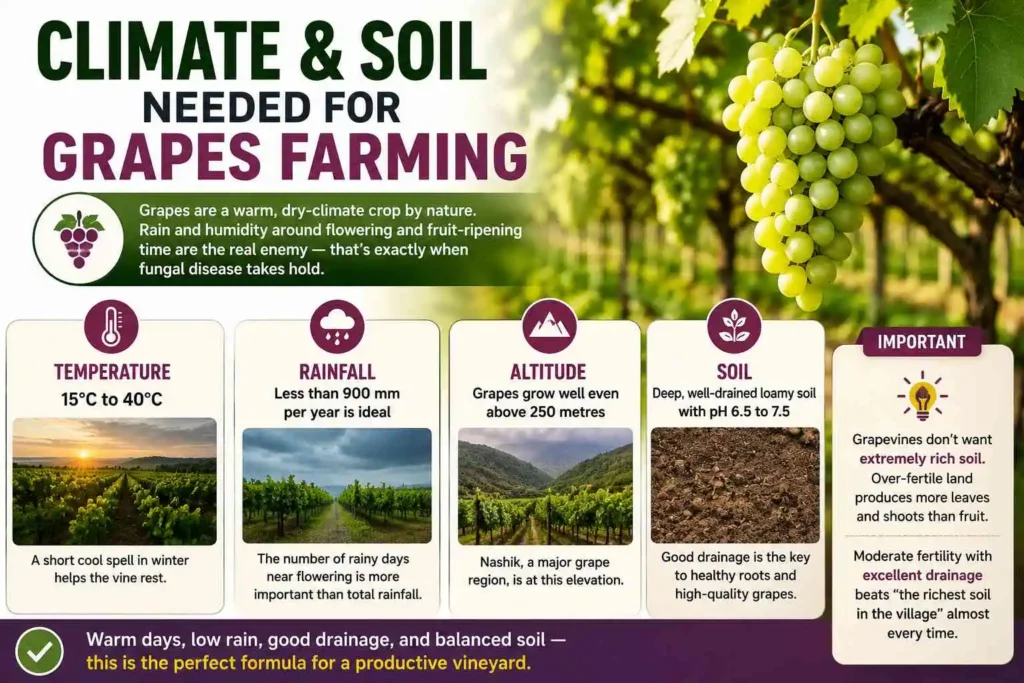
Your variety decides almost everything that follows — yield, disease pressure, and most importantly, the price you’ll get.
| Variety | Type | Best Suited Regions | Approx. Price (₹/kg)* |
|---|---|---|---|
| Thompson Seedless (and mutants: Sonaka, Tas-A-Ganesh, Manik Chaman) | Green, seedless | Maharashtra, Karnataka | 40–80 |
| Sharad Seedless | Black, seedless | Maharashtra, Karnataka | 70–140 |
| Flame Seedless | Red, seedless | Maharashtra | 60–100 |
| Crimson Seedless | Red, seedless | Maharashtra (export-focused) | 80–150 |
| Anab-e-Shahi | Green, seeded, large berry | Andhra Pradesh, Telangana | 40–70 |
| Bangalore Blue | Purple, seeded | Karnataka (juice, wine) | 30–50 |
| Dilkhush | Green, seeded | Karnataka | 40–60 |
Prices vary heavily by season, quality grade, and whether the produce goes for export or the local mandi.
Thompson Seedless and its mutants remain the safest bet for most first-time growers — dependable yield, wide market acceptance, and strong export demand. Growers within reach of a good APMC market or an export packhouse often do better with coloured seedless varieties like Sharad or Crimson, which pay noticeably more per kilo, though they ask for a bit more management skill.
Land Preparation and Planting
Deep plough the field two to three times to break up hard layers and clear old roots and stones. Grapevines usually go into pits 60 to 90 cm deep, though vigorous varieties need bigger pits than seedless ones. Fill each pit back with topsoil mixed with well-rotted farmyard manure and single superphosphate before planting.
Timing matters a lot, and it depends on where you farm:
- Peninsular India (Maharashtra, Karnataka, Andhra Pradesh, Tamil Nadu): plant between November and January
- North India (Punjab, Haryana, Himachal Pradesh, Uttar Pradesh): plant in February–March, since these regions follow a single-crop pattern with growth in spring and harvest in summer
Most growers plant rooted hardwood cuttings, though grafting onto a hardy rootstock (Dogridge is a common choice) is becoming more popular, especially on soils with nematode problems or a touch of salinity. Depending on variety and spacing system, you’ll typically fit somewhere between 450 and 800 vines per acre.
Trellising and Spacing: Give the Vine Something to Climb
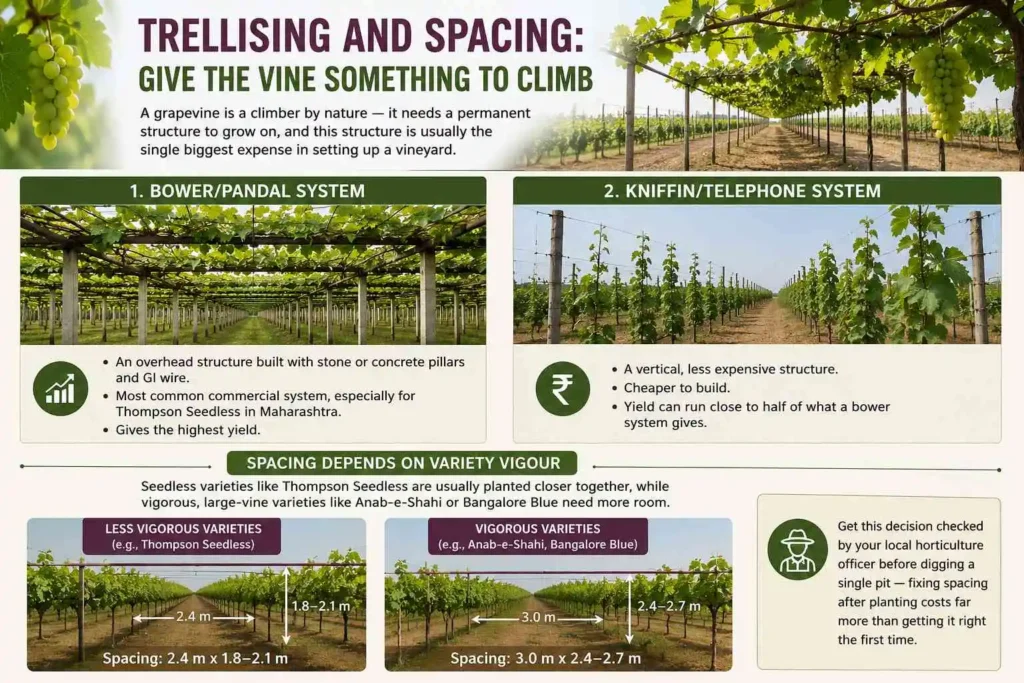
A grapevine is a climber by nature — it needs a permanent structure to grow on, and this structure is usually the single biggest expense in setting up a vineyard.
Two systems dominate commercial grape farming in India:
- Bower/Pandal system: An overhead structure built with stone or concrete pillars and GI wire. This is the most common commercial system, especially for Thompson Seedless in Maharashtra, and it gives the highest yield.
- Kniffin/Telephone system: A vertical, less expensive structure. Cheaper to build, but yield can run close to half of what a bower system gives.
Spacing depends on how vigorous your chosen variety is. Seedless varieties like Thompson Seedless are usually planted closer together, while vigorous, large-vine varieties like Anab-e-Shahi or Bangalore Blue need considerably more room between rows. Get this decision checked by your local horticulture officer before digging a single pit — fixing spacing after planting costs far more than getting it right the first time.
Irrigation for Grapes Farming
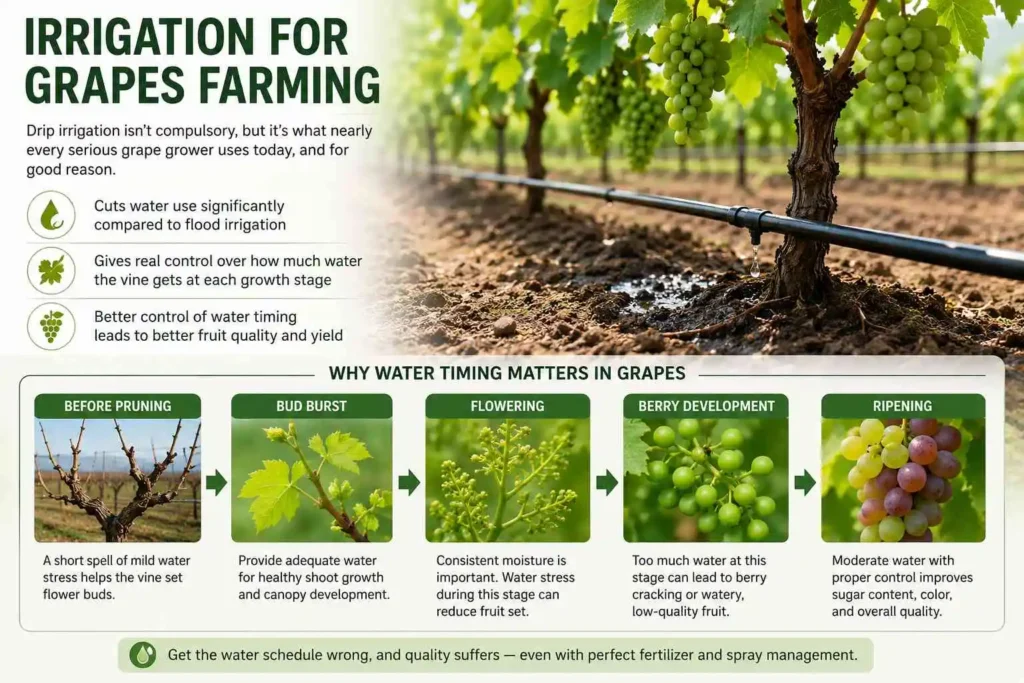
Drip irrigation isn’t compulsory, but it’s what nearly every serious grape grower uses today, and for good reason. It cuts water use significantly compared to flood irrigation, and — more importantly for grapes — it gives real control over how much water the vine gets at each growth stage. You can check the full drip irrigation setup guide.
That control matters because water timing affects fruit quality directly. Too much water at the wrong stage, like during berry development, can crack berries or make them watery. A short spell of mild water stress before pruning actually helps the vine set flower buds. Get the water schedule wrong, and quality suffers even with perfect fertilizer and spray management.
Nutrient and Fertilizer Management
Grapevines are heavy feeders. Because vines across Peninsular India are pruned and cropped more than once in a cycle, they pull a lot of nutrients out of the soil every year.
At planting, mix well-rotted farmyard manure and single superphosphate into the pit. After that, nitrogen, phosphorus, and potash go in as split doses timed around the pruning cycle rather than one big dose. Micronutrient deficiencies — especially iron, zinc, and boron — show up often in grape orchards and are usually corrected through foliar spray rather than soil application.
Get your soil tested before deciding on exact fertilizer quantities. A blanket dose that ignores your specific soil report is one of the most common and easily avoidable ways growers waste money on inputs.
Pruning: The Real Backbone of Grapes Farming
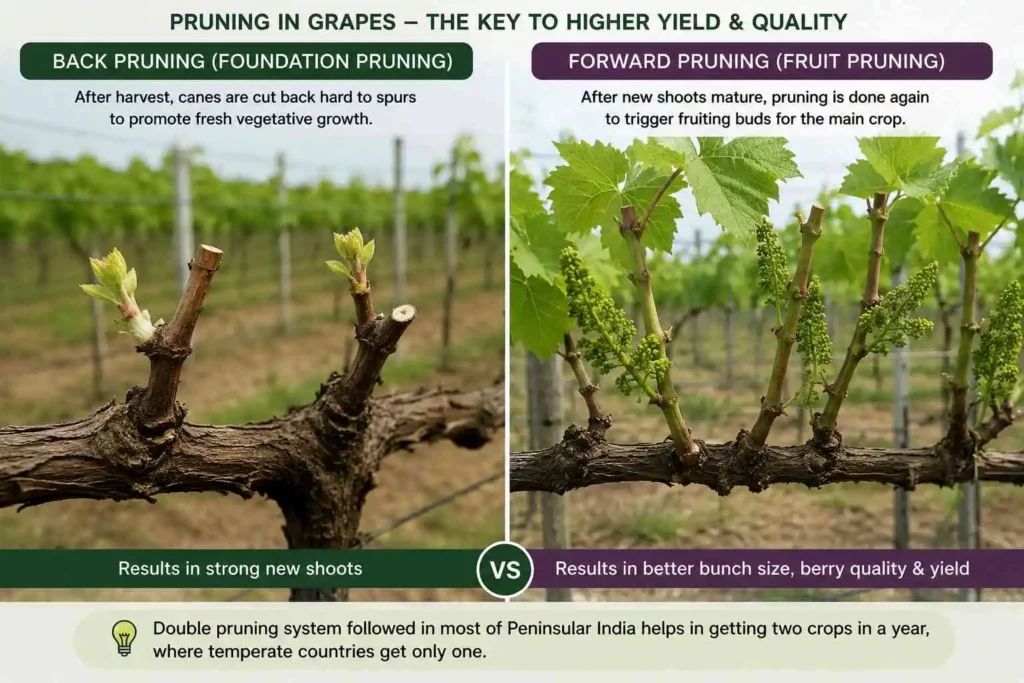
If one skill separates a good grape grower from an average one, it’s pruning. Across most of Peninsular India, grapevines are pruned twice in a cycle, and this double-pruning system is exactly what lets growers here get a crop where temperate countries only manage one.
Here’s broadly how it works:
- Back pruning (foundation pruning): After harvest, the vine rests for three to four weeks with reduced watering. The fruited canes are then cut back hard to spurs, pushing out fresh vegetative growth.
- Forward pruning (fruit pruning): Once these new shoots mature over the following months, they’re pruned again — this time to trigger fruiting buds ahead of the main cropping season.
The exact months shift a bit by region and even farm to farm, so this is one area where a conversation with your local Krishi Vigyan Kendra or an experienced neighbouring grower is worth more than any general calendar. Get the timing and technique right, and bunch size, berry quality, and overall yield all improve together.
Common Pests and Diseases in Grapes Farming
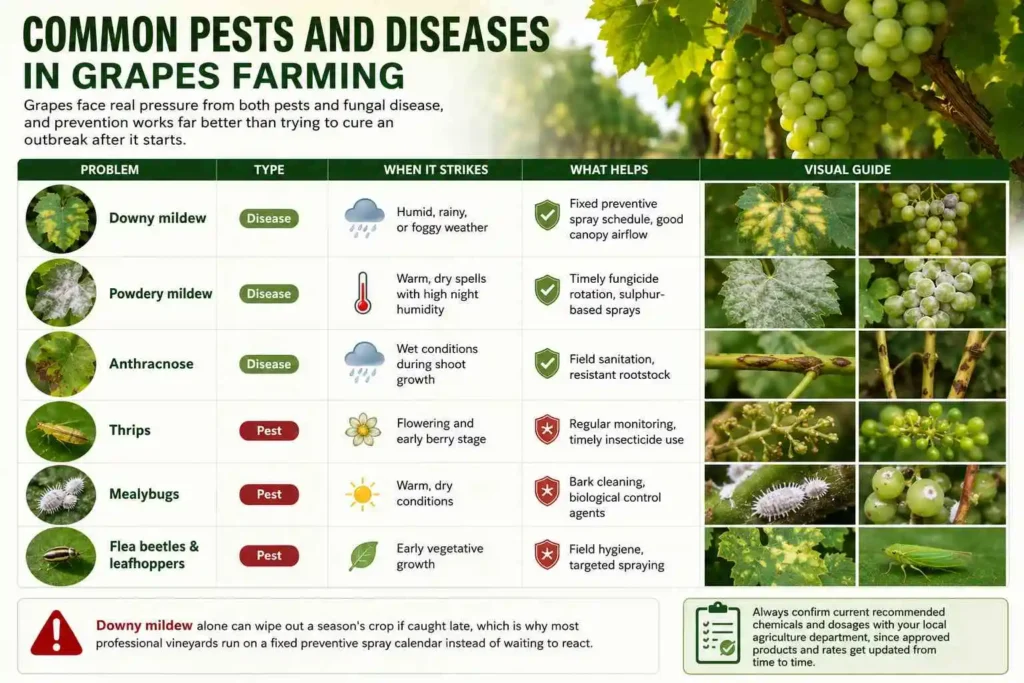
Grapes face real pressure from both pests and fungal disease, and prevention works far better than trying to cure an outbreak after it starts.
| Problem | Type | When It Strikes | What Helps |
|---|---|---|---|
| Downy mildew | Disease | Humid, rainy, or foggy weather | Fixed preventive spray schedule, good canopy airflow |
| Powdery mildew | Disease | Warm, dry spells with high night humidity | Timely fungicide rotation, sulphur-based sprays |
| Anthracnose | Disease | Wet conditions during shoot growth | Field sanitation, resistant rootstock |
| Thrips | Pest | Flowering and early berry stage | Regular monitoring, timely insecticide use |
| Mealybugs | Pest | Warm, dry conditions | Bark cleaning, biological control agents |
| Flea beetles & leafhoppers | Pest | Early vegetative growth | Field hygiene, targeted spraying |
Downy mildew alone can wipe out a season’s crop if caught late, which is why most professional vineyards run on a fixed preventive spray calendar instead of waiting to react. Always confirm current recommended chemicals and dosages with your local agriculture department, since approved products and rates get updated from time to time.
Harvesting and Yield
Grapes don’t ripen any further once picked, so timing the harvest correctly — going by sugar content and colour, not just the calendar — matters enormously. Across most of Peninsular India, harvesting runs roughly from January to April, depending on variety and your pruning schedule.
On yield: the National Horticulture Board’s FY24 data puts India’s average at around 9 tonnes per acre. That’s the realistic national baseline. With good scientific management — correct pruning, disciplined spraying, and drip irrigation — 15 to 20 tonnes per acre is achievable, and some highly experienced growers with premium varieties have reported even higher figures. Harvesting is done by hand, with sorting happening right at the point of picking to remove damaged or diseased bunches.
Cost of Grapes Farming Per Acre (in ₹)
This is the part every serious grower wants clear numbers on. The figures below are based on published economic studies from grape-growing districts of Maharashtra and current input costs — treat them as a planning guide, since actual costs shift with your region, labour rates, and the season.
Establishment cost (Year 1, one-time)
| Head | Approx. Cost (₹/acre) |
|---|---|
| Land preparation & pit digging | 15,000 – 20,000 |
| Planting material (500–600 vines) | 15,000 – 25,000 |
| Trellis/mandap structure | 2,50,000 – 4,00,000 |
| Drip irrigation system | 35,000 – 50,000 |
| Basal manure & fertilizer | 20,000 – 30,000 |
| Plant protection | 15,000 – 20,000 |
| Labour | 20,000 – 30,000 |
| Total | 3,70,000 – 5,75,000 |
Annual cultivation cost (from Year 2 onward)
| Head | Approx. Cost (₹/acre) |
|---|---|
| Fertilizers & micronutrients | 30,000 – 40,000 |
| Plant protection (spray schedule) | 40,000 – 60,000 |
| Labour (pruning, training, harvesting) | 55,000 – 75,000 |
| Irrigation & electricity | 10,000 – 15,000 |
| Packing, transport & miscellaneous | 15,000 – 20,000 |
| Total | 1,50,000 – 2,70,000 |
Notice how much of the establishment cost goes into the trellis alone — often well over half. This is why grapes farming rewards farmers who build the structure right the first time instead of cutting corners early and paying for repairs later.
Profit Potential in Grapes Farming (in ₹)
Profit depends heavily on the vineyard’s age, the variety grown, and how the produce is sold — mandi, direct trader, or export. Here’s a realistic picture across three stages:
| Stage | Yield (tonnes/acre) | Price (₹/kg) | Gross Revenue (₹) | Approx. Net Profit (₹)* |
|---|---|---|---|---|
| Young vineyard (Year 2–3) | 3 – 6 | 40 – 70 | 1.2 – 4.2 lakh | Often break-even to modest profit |
| Typical mature vineyard | 8 – 12 | 50 – 90 | 4 – 10.8 lakh | 2 – 6 lakh |
| Well-managed, export-quality vineyard | 15 – 20+ | 90 – 140 | 13.5 – 28 lakh+ | 10 – 20 lakh+ |
After deducting the annual cultivation cost shown above. Establishment cost is recovered gradually across the vineyard’s 15–25 year productive life, not in a single season.
The gap between “typical” and “well-managed” is wide, and it’s earned rather than lucky. It comes down to variety choice, disciplined pruning and spraying, drip irrigation, and access to a better-paying market — not shortcuts.
Government Schemes and Subsidy for Grape Farmers
The good news is that none of this has to come entirely out of your own pocket.
- MIDH (Mission for Integrated Development of Horticulture): This central scheme supports orchard establishment, planting material, and infrastructure like pack-houses and cold storage, with assistance that can cover a substantial share of eligible costs depending on the activity and your state.
- PMKSY – Per Drop More Crop: Covers drip and micro-irrigation systems, with subsidy typically ranging from around 55% for general farmers up to 75% for small and marginal farmers, though the exact rate depends on your state’s top-up.
- APEDA support: For export-focused growers, APEDA facilitates RCMC registration, the GrapeNet traceability system (mandatory for EU exports), and GlobalGAP certification guidance.
To apply, start with your District Horticulture Officer or State Horticulture Mission office, with your land records and Aadhaar documents ready. Subsidy percentages, eligible activities, and application windows change from year to year and state to state, so confirm current details with your local Krishi Vigyan Kendra before you plan your budget around them.
Marketing and Export Opportunities
In the most recent full season on record (FY 2023-24), India exported over 3.4 lakh tonnes of fresh grapes worth around ₹3,460 crore, mainly to the Netherlands, UK, Bangladesh, UAE, and Russia, with the Netherlands alone taking a large share of that volume. India’s harvest window of January to April is a genuine strategic advantage — it lines up with the off-season for several Northern Hemisphere competitors, which supports better pricing in European markets during those months.
For export, you’ll need APEDA’s RCMC registration, GrapeNet traceability enrolment, a phytosanitary certificate, and usually GlobalGAP certification for the EU market. That’s a lot for an individual grower to manage alone, which is exactly why cooperative marketing groups — Maharashtra’s Mahagrapes is a well-known example — exist to help smaller growers reach export markets and better prices without each farmer building the entire compliance system from scratch.
Domestically, selling through a Farmer Producer Organisation (FPO) rather than an individual trader almost always improves bargaining position, especially during peak harvest weeks when local mandi prices can dip sharply.
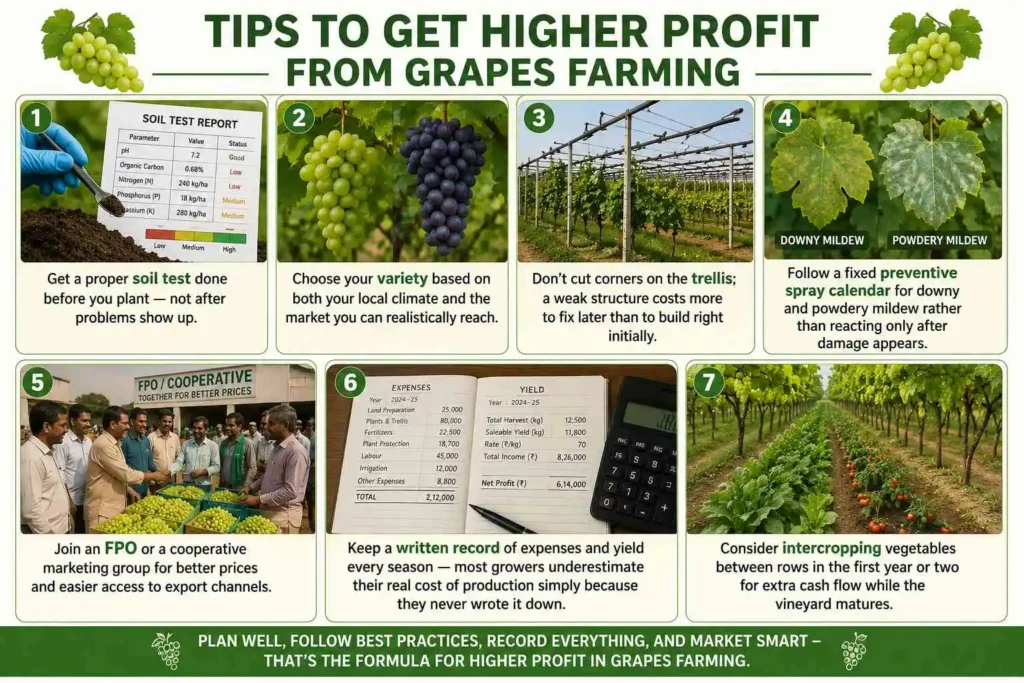
Tips to Get Higher Profit from Grapes Farming
- Get a proper soil test done before you plant — not after problems show up
- Choose your variety based on both your local climate and the market you can realistically reach
- Don’t cut corners on the trellis; a weak structure costs more to fix later than to build right initially
- Follow a fixed preventive spray calendar for downy and powdery mildew rather than reacting only after damage appears
- Join an FPO or a cooperative marketing group for better prices and easier access to export channels
- Keep a written record of expenses and yield every season — most growers underestimate their real cost of production simply because they never wrote it down
- Consider intercropping vegetables between rows in the first year or two for extra cash flow while the vineyard matures.
Conclusion
Grapes farming rewards patience, discipline, and attention to detail far more than it rewards luck. The upfront cost is real, and so is the ongoing work of pruning and spraying on schedule — but a vineyard set up correctly can support a family’s income for two decades or more from one planting. Before putting a single cutting in the ground, talk to your local Krishi Vigyan Kendra or horticulture office, get your soil tested, and study what’s actually selling well in your nearest market. Get those basics right, and grapes farming can genuinely become one of the better long-term decisions you make for your land.
FAQs on Grapes Farming
How many years does it take for a grape plant to give fruit?
Commercial harvesting usually starts in the 2nd or 3rd year after planting, with the vine reaching full yield potential by around year 4 or 5.
How much land do I need to start grapes farming?
Even half an acre to one acre is enough to start, though most commercial growers work with two acres or more to make the trellis investment worthwhile.
Is drip irrigation compulsory for grapes farming?
It’s not compulsory, but it’s strongly recommended. It saves water, gives better control over vine growth stages, and most export-quality vineyards already use it. Subsidy support is available under PMKSY.
Which is the most profitable grape variety in India?
There’s no single best variety for everyone — it depends on soil, climate, and market access. Coloured seedless varieties like Sharad Seedless and Crimson Seedless often fetch higher prices, but Thompson Seedless remains the most dependable choice for most first-time growers.
How long does a grape vineyard keep producing?
A well-maintained vineyard typically stays productive for 15 to 25 years from a single planting.
What’s the biggest cost in setting up a vineyard?
The trellis or “mandap” structure — it usually accounts for more than half of the total establishment cost.
Newsletter