


How to Start a Layer Poultry Farm: Setup, Cost, Profit & ROI (2026)
Open your kitchen shelf right now. Chances are there’s a tray of eggs sitting on it. Multiply that tray by more than 140 crore Indians, and you start to understand why a layer poultry farm is one of the steadiest businesses in Indian agriculture today. Unlike a crop that pays once a season, or broilers that pay once every five to six weeks, a layer poultry farm pays you almost every single day, for close to a year and a half, from one batch of birds.
That said, a layer poultry farm is not a “set it and forget it” business. Feed costs eat into margins fast. One missed vaccine can wipe out a flock’s earnings. This guide breaks down exactly what a layer poultry farm needs — breed selection, shed type, feed schedule, health protection, and honest cost tables in rupees — so you can plan with facts, not guesswork.
What Is a Layer Poultry Farm?
A layer poultry farm is a business built around raising hens purely for egg production, not meat. “Layer” simply describes a hen bred and managed to lay eggs consistently — as many as 300 or more a year under good management.
This is different from broiler farming, where birds are raised for five to seven weeks and then sold for meat. A layer bird, by contrast, starts laying at around 18-20 weeks of age and keeps laying for 72-78 weeks straight. That long, steady production window is exactly what makes a layer poultry farm attractive: one round of chicks gives you income for well over a year.
Why Layer Poultry Farming Makes Sense in India Right Now
A few numbers explain the opportunity better than any sales pitch:
- Egg demand is climbing fast. Government of India data shows per-person egg availability has grown from around 62 eggs a year in 2014-15 to over 100 today — nearly doubling in a decade.
- India is among the world’s top three egg-producing nations, yet per-person consumption still lags nutritional recommendations, so the domestic market still has real room to grow.
- Eggs are the cheapest source of animal protein in the country, which keeps baseline demand strong across income groups and through the year.
- A layer poultry farm gives you a second income stream. Poultry manure is a sought-after organic fertiliser, and even 1,000 birds can generate several thousand rupees a month in manure sales alone.
- Government-backed loans and subsidy schemes (covered later in this guide) bring the entry cost down more than most first-time farmers assume.
None of this makes the business risk-free. But the underlying demand story for eggs in India is genuinely strong, and that is the foundation any layer poultry farm business plan should be built on.
Best Layer Breeds for a Commercial Layer Poultry Farm
Your breed choice decides your egg output, feed efficiency, and how well your birds handle Indian summers. Here are the breeds most Indian layer poultry farms rely on:
| Breed | Egg Colour | Eggs per Bird / Year (approx.) | Known For |
|---|---|---|---|
| BV-380 | Brown | 295 – 310 | Developed by ICAR-CARI; hardy in Indian heat; popular with small farms |
| Bovans Brown | Brown | 300 – 320 | High peak production; widely used by large integrators |
| Hy-Line Brown | Brown | 300 – 320 | Excellent feed-to-egg conversion; strong shell quality |
| White Leghorn | White | 290 – 310 | Lighter body, eats less feed, very heat-tolerant |
| Babcock B-380 | Brown | 290 – 300 | Reliable, widely available through certified hatcheries |
Brown-egg breeds currently dominate Indian retail demand, since many consumers associate a brown shell with “desi” or farm-fresh eggs — even though shell colour has no real effect on nutrition. If your local market prefers white eggs, White Leghorn remains the safer choice.
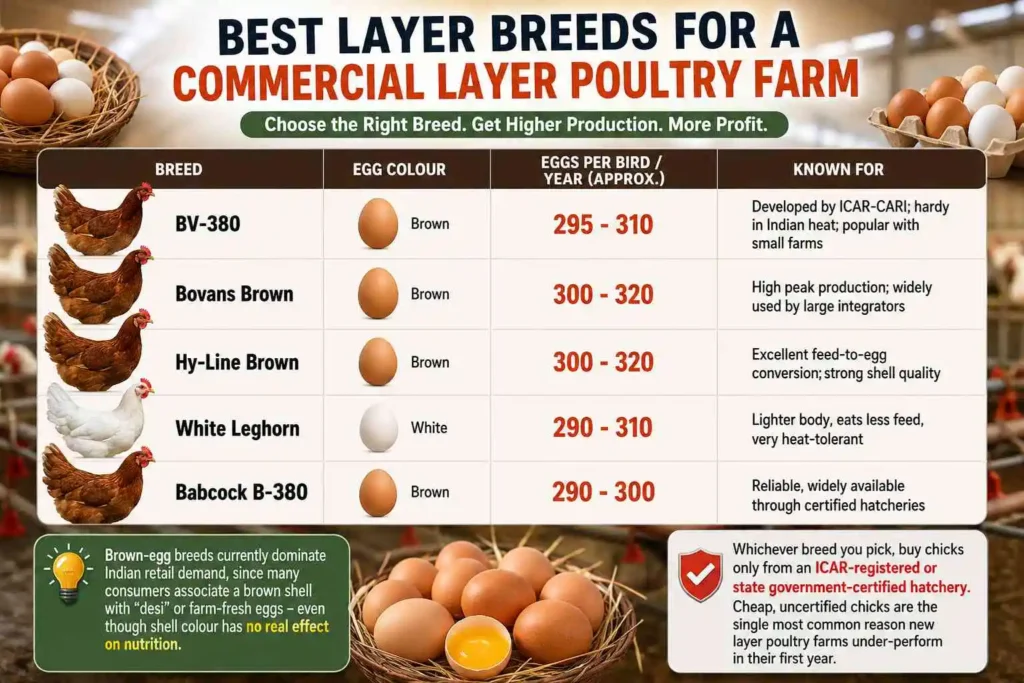
Whichever breed you pick, buy chicks only from an ICAR-registered or state government-certified hatchery. Cheap, uncertified chicks are the single most common reason new layer poultry farms under-perform in their first year. Once you’ve sourced healthy chicks, the next critical step is getting their brooding conditions right
How to Set Up a Layer Poultry Farm: Step by Step
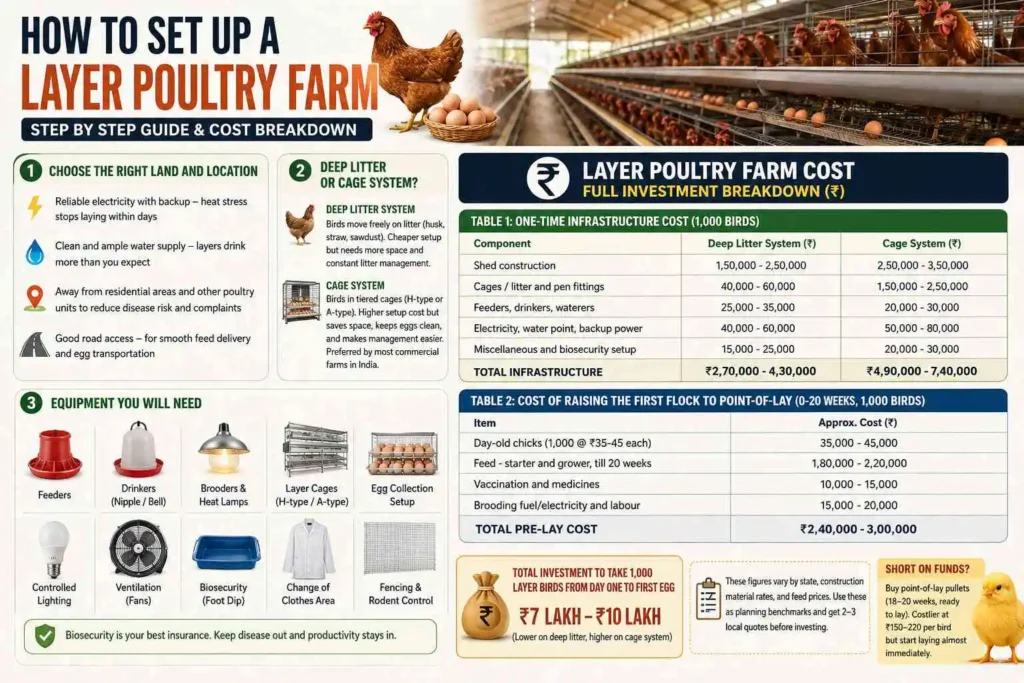
1. Choose the Right Land and Location
For 1,000 birds, plan on roughly 800 – 1,200 square feet of covered shed area (about 0.8 – 1 square foot per bird in a cage system; deep litter needs more room). Look for a site with:
- Reliable electricity, plus a backup source — birds under heat stress stop laying within days
- A clean, generous water supply — layers drink more than people expect, and any shortage crashes egg production fast
- Some distance from residential clusters and other poultry units, to lower disease risk and avoid local complaints
- Good road access, so feed comes in and eggs go out without delay or breakage
2. Deep Litter or Cage System?
This is the first big decision every new layer poultry farm owner faces.
- Deep litter system: Birds move freely on a floor covered with husk, straw, or sawdust. Cheaper to set up, but needs more space per bird, and litter management — moisture and ammonia smell — needs constant attention.
- Cage system (battery cages): Birds are housed in tiered wire cages, usually H-type or A-type frames. Costs more upfront, but uses far less floor space, keeps eggs cleaner, and makes disease control and egg collection much easier. Most new commercial layer poultry farms in India are now built around cage systems for exactly these reasons.
3. Equipment You Will Need
Feeders and drinkers (manual or nipple-line), brooders and heat lamps for the first few weeks, an egg-collection setup, controlled lighting (layers need fixed light hours to trigger and sustain production), and basic biosecurity gear — foot-dip trays, a change-of-clothes area, and fencing to keep out wild birds and rodents. You can also check the dedicated blog on equipment required in poultry farm.
Layer Poultry Farm Cost: Full Investment Breakdown (₹)
Most first-time farmers only budget for the shed, and forget the cost of raising the first batch of chicks until they actually start laying. Here is a realistic breakdown for a 1,000-bird layer poultry farm, split into infrastructure and the first flock’s running cost.
Table 1: One-Time Infrastructure Cost (1,000 Birds)
| Component | Deep Litter System (₹) | Cage System (₹) |
|---|---|---|
| Shed construction | 1,50,000 – 2,50,000 | 2,50,000 – 3,50,000 |
| Cages / litter and pen fittings | 40,000 – 60,000 | 1,50,000 – 2,50,000 |
| Feeders, drinkers, waterers | 25,000 – 35,000 | 20,000 – 30,000 |
| Electricity, water point, backup power | 40,000 – 60,000 | 50,000 – 80,000 |
| Miscellaneous and biosecurity setup | 15,000 – 25,000 | 20,000 – 30,000 |
| Total Infrastructure | ₹2,70,000 – 4,30,000 | ₹4,90,000 – 7,40,000 |
Table 2: Cost of Raising the First Flock to Point-of-Lay (0-20 weeks, 1,000 birds)
| Item | Approx. Cost (₹) |
|---|---|
| Day-old chicks (1,000 @ ₹35-45 each) | 35,000 – 45,000 |
| Feed – starter and grower, till 20 weeks | 1,80,000 – 2,20,000 |
| Vaccination and medicines | 10,000 – 15,000 |
| Brooding fuel/electricity and labour | 15,000 – 20,000 |
| Total Pre-Lay Cost | ₹2,40,000 – 3,00,000 |
Add both tables, and a realistic total investment to take 1,000 layer birds from day one to their first egg comes to roughly ₹7 lakh to ₹10 lakh on a cage system, a little lower on deep litter. This is close to what banks typically use as a benchmark project cost when sanctioning loans for 1,000-bird layer units.
Honest note: these figures move with your state, local steel and cement prices, and current feed rates. Treat them as planning benchmarks, and get two or three local quotes before you commit money.
Short on funds? Consider buying point-of-lay pullets (18-20 weeks old, ready to start laying) instead of day-old chicks. They cost more per bird — typically ₹150-220 — but you skip the riskiest, most labour-intensive rearing phase entirely.
Feed Management: The Cost That Decides Your Profit
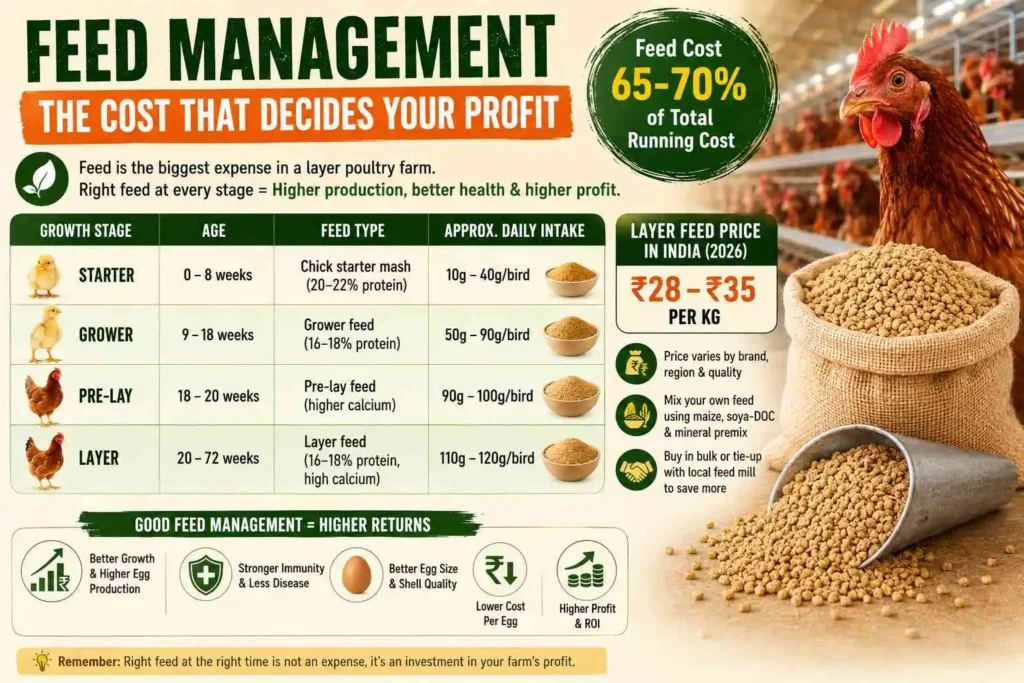
Feed alone typically accounts for 65-70% of the total running cost of any layer poultry farm. Get this wrong, and no amount of good breed selection will save your margins.
| Growth Stage | Age | Feed Type | Approx. Daily Intake |
|---|---|---|---|
| Starter | 0 – 8 weeks | Chick starter mash (20-22% protein) | 10g – 40g/bird |
| Grower | 9 – 18 weeks | Grower feed (16-18% protein) | 50g – 90g/bird |
| Pre-lay | 18 – 20 weeks | Pre-lay feed (higher calcium) | 90g – 100g/bird |
| Layer | 20 – 72 weeks | Layer feed (16-18% protein, high calcium) | 110g – 120g/bird |
Layer feed in the Indian market currently runs roughly ₹28-35 per kg, depending on brand, region, and whether you buy ready-made feed or mix your own using maize, soya-DOC, and a mineral premix. Farmers who mix their own feed, or tie up directly with a local feed mill, usually save the most on this line — worth the extra effort once you cross 1,000-2,000 birds.
Health Care and Vaccination Schedule for Layer Birds
A single missed vaccine can undo a year of planning . Here is the standard schedule followed across Indian layer poultry farms: You can also check full dedicated guide on disease in poultry farming.
| Age | Disease Covered | Common Method |
|---|---|---|
| Day 1 (at hatchery) | Marek’s Disease | Injection under the skin |
| Day 5-7 | Newcastle Disease + Infectious Bronchitis | Eye drop / drinking water |
| Day 14-16 | Gumboro (IBD) | Drinking water |
| Week 4-5 | Gumboro booster | Drinking water |
| Week 6-8 | Fowl Pox | Wing-web prick |
| Week 8-10 | Newcastle Disease booster | Drinking water / injection |
| Week 14-16 | Fowl Coryza (in high-risk areas) | Injection |
| Week 16-18 | ND + IB booster (before lay begins) | Injection |
| Every 8 weeks | Deworming | Oral |
Beyond vaccines, watch ventilation and litter moisture closely. Wet litter and poor airflow are the two most common triggers for respiratory illness and coccidiosis in Indian sheds, especially through the monsoon.
Understanding the Egg-Laying Cycle
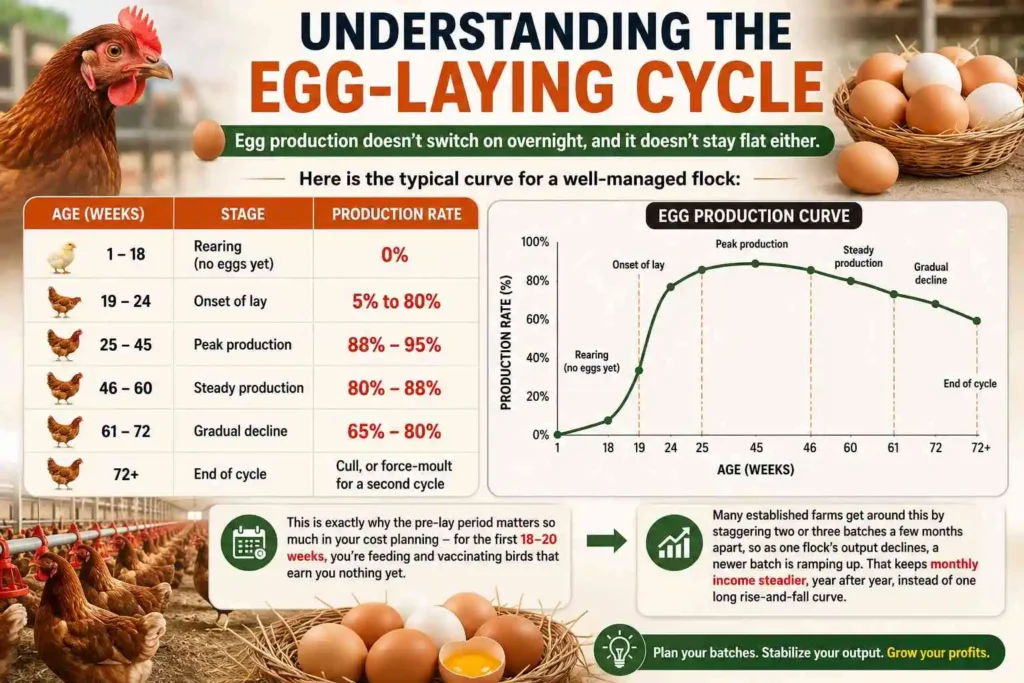
Egg production doesn’t switch on overnight, and it doesn’t stay flat either. Here is the typical curve for a well-managed flock:
| Age (weeks) | Stage | Production Rate |
|---|---|---|
| 1-18 | Rearing (no eggs yet) | 0% |
| 19-24 | Onset of lay | 5% to 80% |
| 25-45 | Peak production | 88% – 95% |
| 46-60 | Steady production | 80% – 88% |
| 61-72 | Gradual decline | 65% – 80% |
| 72+ | End of cycle | Cull, or force-moult for a second cycle |
This is exactly why the pre-lay period matters so much in your cost planning — for the first 18-20 weeks, you’re feeding and vaccinating birds that earn you nothing yet. Many established farms get around this by staggering two or three batches a few months apart, so as one flock’s output declines, a newer batch is ramping up. That keeps monthly income steadier, year after year, instead of one long rise-and-fall curve.
Monthly Income and Profit: A 1,000-Bird Layer Poultry Farm
Here are real rupee figures for a 1,000-bird cage-system farm during a peak production month (around 87% average lay rate).
| Item | Monthly Amount (₹) |
|---|---|
| Egg sales (approx. 26,000 eggs @ ₹6/egg, wholesale/NECC rate) | 1,56,000 |
| Manure sales | 2,500 |
| Total Income | 1,58,500 |
| Feed cost (approx. 3,300 kg @ ₹30/kg) | 99,000 |
| Labour | 10,000 |
| Electricity and water | 4,000 |
| Medicines and supplements | 3,000 |
| Miscellaneous (transport, trays, repairs) | 3,000 |
| Total Expenses | 1,19,000 |
| Net Profit (Peak Month) | approx. ₹39,500 |
Production isn’t this high every month — it ramps up slowly after week 18 and tapers off after week 60, while feed cost stays roughly fixed regardless of how many eggs the birds actually lay. Averaged across a full 12-month laying period, a well-managed 1,000-bird layer poultry farm typically nets somewhere between ₹3 lakh and ₹4 lakh, once the pre-lay investment is behind you. Most well-run units recover their full setup cost within 18-24 months.
Egg prices — set as a daily advisory rate by the National Egg Coordination Committee (NECC) — move with season and region, usually somewhere between ₹5 and ₹7 per egg at the wholesale level. Track your local NECC rate weekly; it’s the single biggest swing factor in your monthly income.
Selling Your Eggs: Where the Market Is
A layer poultry farm’s profit depends as much on where you sell as on how well you farm. Common channels include:
- Local wholesalers and mandi traders, who follow the daily NECC-advised rate
- Hotels, bakeries, and institutional buyers (hostels, canteens), who often pay a small premium for regular, reliable supply
- Direct retail to nearby households and small shops — usually the best price per egg, but it takes more of your time
- Contract or tie-up arrangements with larger poultry integrators, useful once you scale past a few thousand birds
Whatever you choose, avoid depending on a single buyer. If that one buyer walks away or renegotiates price, your entire monthly income is exposed.
Government Subsidy and Loan Schemes for Layer Poultry Farms
Setting up a layer poultry farm doesn’t have to come entirely out of your own pocket. The main scheme to know is the Poultry Venture Capital Fund (PVCF), run under the Entrepreneurship Development and Employment Generation (EDEG) component of the National Livestock Mission, with NABARD as the implementing agency. In plain terms, here’s how it works:
- You take a loan from a bank — commercial, cooperative, or regional rural — covering at least 40% of your total project cost.
- Once you begin repaying on schedule, NABARD releases a back-ended capital subsidy: 25% of the project cost for general-category applicants, and 33.33% for SC/ST farmers and those in hilly or North-Eastern states. Women-led groups and certain backyard-poultry components can sometimes access a higher slab.
- You apply through your nearest bank branch, or check current eligibility on the National Livestock Mission portal.
Many states also run their own poultry development schemes — subsidised sheds, chick distribution, or interest subvention — through their Animal Husbandry departments. Check with your local Block-level Veterinary Officer or nearest Krishi Vigyan Kendra (KVK) for schemes currently active in your state, since these change more often than the central ones.
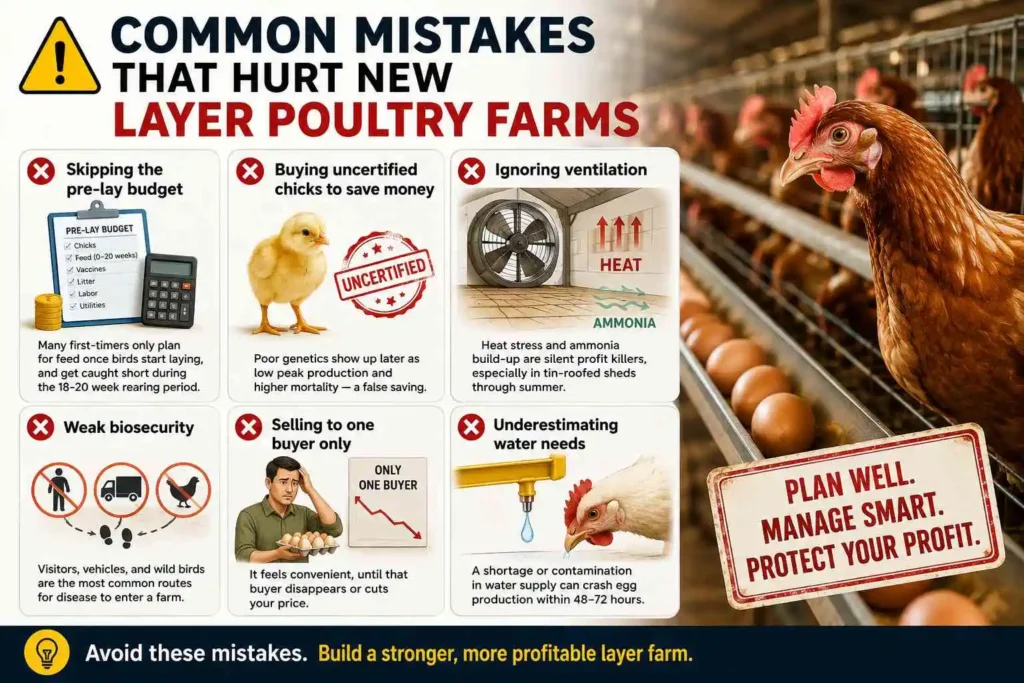
Common Mistakes That Hurt New Layer Poultry Farms
- Skipping the pre-lay budget. Many first-timers only plan for feed once birds start laying, and get caught short during the 18-20 week rearing period.
- Buying uncertified chicks to save money. Poor genetics show up later as low peak production and higher mortality — a false saving.
- Ignoring ventilation. Heat stress and ammonia build-up are silent profit killers, especially in tin-roofed sheds through summer.
- Weak biosecurity. Visitors, vehicles, and wild birds are the most common routes for disease to enter a farm.
- Selling to one buyer only. It feels convenient, until that buyer disappears or cuts your price.
- Underestimating water needs. A shortage or contamination in water supply can crash egg production within 48-72 hours.
Final Word
A layer poultry farm is not a get-rich-quick scheme, and anyone who tells you otherwise is conveniently skipping over the pre-lay period. But get the fundamentals right — a certified breed, the right housing system, disciplined feeding, and a vaccination calendar you never skip — and it becomes one of the most dependable, recession-resistant businesses available to Indian farmers today. Start with numbers you can verify locally, not just numbers from a blog post, and build from there.
Frequently Asked Questions
How many eggs does one layer hen produce in a year?
A good commercial layer hen produces roughly 290-320 eggs a year under proper feed, lighting, and health management.
Is layer farming more profitable than broiler farming?
Broilers pay back faster — in five to seven weeks — but in one lump sum per batch. A layer poultry farm pays smaller amounts daily for over a year, giving steadier, spread-out income. Many experienced farmers see layer farming as the better long-term, lower-stress business once they can afford the higher starting investment.
How much land do I need to start a layer poultry farm with 1,000 birds?
Roughly 800-1,200 square feet of covered shed space, plus room for feed storage, a water source, and vehicle access.
Can I start a layer poultry farm on a small budget?
Yes — many farmers start with 300-500 birds on a deep litter system for roughly ₹1.5-2.5 lakh, including the first flock, then scale up once the business proves itself.
What is the productive lifespan of a layer hen?
Layer hens typically lay from around 18-20 weeks of age until 72-78 weeks, after which farmers either cull the flock or attempt a force-moult for a second, shorter laying cycle.
Newsletter




I want to start a poultry business in Haiti.
Could you please help me secure funding for the building and launching of the farm?
Best regards,
Hi Philippe,
Thank you for your comment, and I wish you the very best with your poultry farming plans in Haiti.
Unfortunately, I’m not able to help secure funding directly. However, I’d be happy to answer your questions about poultry farm planning, breed selection, housing, feeding, budgeting, or management to help you get started.
You may also want to explore agricultural grants, local government programs, NGOs, or microfinance institutions in Haiti that support small farming businesses.
Feel free to ask any specific questions here—I’ll do my best to help.
Hi 👋 interested
Hi Vladimir! 👋
Thank you for your interest. I’m glad you found the article helpful.
If you have any questions about starting or managing a layer poultry farm, feel free to ask—I’ll be happy to help.
You may also find my other poultry farming guides and agriculture articles useful as you plan your farm.