



Vertical Farming in India: Cost, Subsidy and Profit (2026)
Vertical farming in India is no longer just something you read about in a foreign magazine. It has quietly turned into a real, working business. Right now, entrepreneurs, agriculture graduates, and even traditional farmers are setting up vertical farms inside warehouses, shipping containers, and city rooftops across the country.
Why the sudden interest? India is running short on two things every farmer needs: land and water. Cities keep expanding into farmland. Groundwater is falling in state after state. And city buyers want fresh, chemical-free vegetables all year round, not just in season. Vertical farming answers all four problems at once, by growing crops in stacked layers instead of spreading them across open fields.
This guide breaks down vertical farming in India in plain language — how it actually works, what it costs, which government schemes can cut your bill in half, and whether it can genuinely make money. Every number here is in rupees, and we’ve kept the jargon to a minimum.
Vertical farming in India — quick facts
- Government subsidy available: up to 75% under Kerala’s Arka scheme, 40–50% under the National Horticulture Board
- Setup cost: ₹10,000 for a home unit to ₹1.5 crore+ for a 1-acre automated commercial farm
- Typical payback period: 18 months to 5 years
- Water used: up to 90–95% less than open-field farming
- Best crops: leafy greens, herbs, microgreens, strawberries, cherry tomatoes

What Is Vertical Farming? A Simple Explanation
Picture a bookshelf. Instead of books, each shelf holds a tray of lettuce, spinach, or mint. That’s vertical farming in one image — growing crops in stacked layers, one above the other, instead of across a flat field.
Because the layers stack up, one small room can grow as much as several acres of open land. Most vertical farms skip soil completely and use one of three methods:
- Hydroponics – Plant roots sit directly in nutrient-rich water. No soil at all. This is the most common method used in vertical farming in India today.
- Aeroponics – Roots hang in air and get misted with nutrients every few minutes. Uses even less water than hydroponics.
- Aquaponics – Combines fish farming with plant growing. Fish waste feeds the plants; the plants clean the water that goes back to the fish.
LED lights do the sun’s job. Sensors track temperature, humidity, and nutrient levels around the clock. The payoff: fresh vegetables, harvested 12 months a year, whatever the weather is doing outside.
Why Vertical Farming in India Is Growing So Fast
India is genuinely running low on farmland and water. Rapid urban growth keeps eating into land near cities — exactly where demand for fresh food is highest. Groundwater stress is also a documented, serious problem across large parts of the country.
Vertical farming addresses both pressures directly. It uses up to 90–95% less water than open-field farming, and needs only a small footprint of land, because you’re building up, not spreading out.
Market researchers don’t fully agree on how big India’s vertical farming industry actually is today — estimates vary a lot depending on what’s counted. One widely cited report values the current market at around US$360 million (roughly ₹3,000–3,500 crore), expecting it to cross US$1.9 billion (around ₹16,000–18,000 crore) by 2033. Other research firms land on different absolute numbers. But nearly every forecast agrees on one thing: the sector is growing at 18–24% every year, among the fastest growth rates anywhere in Indian agriculture.
Geographically, South India — Bengaluru, Hyderabad, and Chennai in particular — currently leads the country, helped by a strong agri-tech startup scene and a large base of urban buyers willing to pay more for fresh, pesticide-free produce. Delhi-NCR, Mumbai, and Pune follow close behind.
Building-Based vs Container Farms — and What Actually Gets Grown
Vertical farms in India usually take one of two shapes.
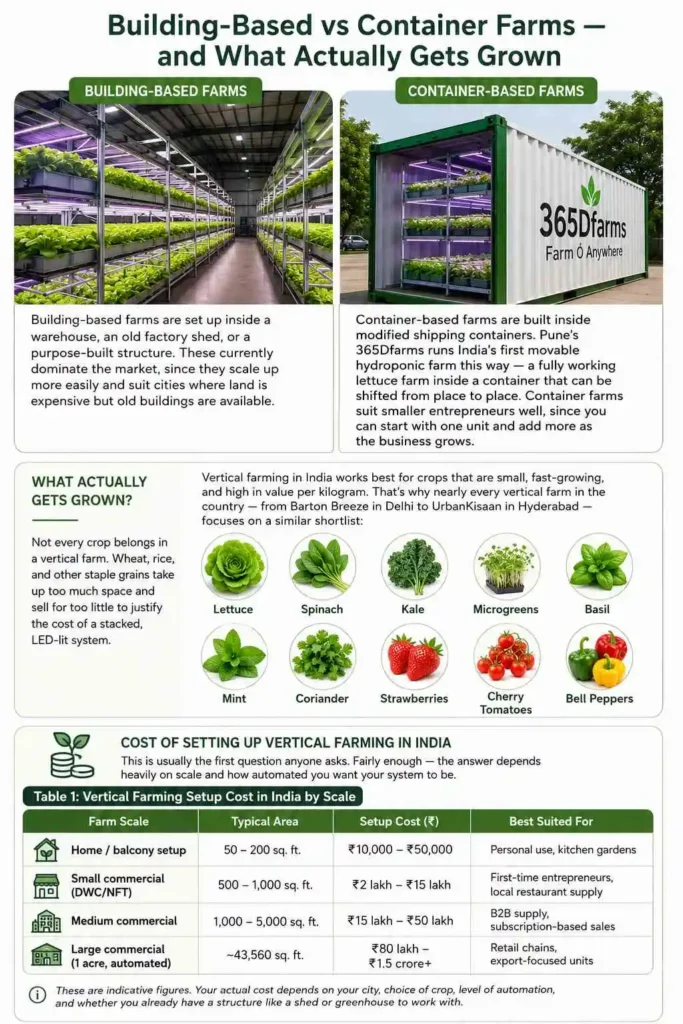
Building-based farms are set up inside a warehouse, an old factory shed, or a purpose-built structure. These currently dominate the market, since they scale up more easily and suit cities where land is expensive but old buildings are available.
Container-based farms are built inside modified shipping containers. Pune’s 365Dfarms runs India’s first movable hydroponic farm this way — a fully working lettuce farm inside a container that can be shifted from place to place. Container farms suit smaller entrepreneurs well, since you can start with one unit and add more as the business grows.
Not every crop belongs in a vertical farm. Wheat, rice, and other staple grains take up too much space and sell for too little to justify the cost of a stacked, LED-lit system. Vertical farming in India works best for crops that are small, fast-growing, and high in value per kilogram. That’s why nearly every vertical farm in the country — from Barton Breeze in Delhi to UrbanKisaan in Hyderabad — focuses on a similar shortlist: lettuce, spinach, kale, microgreens, basil, mint, coriander, strawberries, cherry tomatoes, and bell peppers.
Cost of Setting Up Vertical Farming in India
This is usually the first question anyone asks. Fairly enough — the answer depends heavily on scale and how automated you want your system to be.
Table 1: Vertical Farming Setup Cost in India by Scale
| Farm Scale | Typical Area | Setup Cost (₹) | Best Suited For |
|---|---|---|---|
| Home / balcony setup | 50 – 200 sq. ft. | ₹10,000 – ₹50,000 | Personal use, kitchen gardens |
| Small commercial (DWC/NFT) | 500 – 1,000 sq. ft. | ₹2 lakh – ₹15 lakh | First-time entrepreneurs, local restaurant supply |
| Medium commercial | 1,000 – 5,000 sq. ft. | ₹15 lakh – ₹50 lakh | B2B supply, subscription-based sales |
| Large commercial (1 acre, automated) | ~43,560 sq. ft. | ₹80 lakh – ₹1.5 crore+ | Retail chains, export-focused units |
These are indicative figures. Your actual cost depends on your city, choice of crop, level of automation, and whether you already have a structure like a shed or greenhouse to work with.
Here’s where that money typically goes, component by component:
Table 2: Where the Setup Money Goes
| Cost Component | Approximate Cost | What It Covers |
|---|---|---|
| Structure (polyhouse/greenhouse) | ₹150 – ₹500 per sq. ft. | From a basic polyhouse to a fully sealed glasshouse |
| Growing system (NFT/DWC/drip racks) | ₹400 – ₹2,000 per sq. ft. | Depends on how many layers you stack |
| LED grow lights | ₹5,000 – ₹30,000 per panel | Commercial multi-layer setups: ₹2 lakh – ₹10 lakh+ |
| Sensors & smart monitoring | ₹50,000 – ₹5 lakh+ | pH, EC, and humidity sensors with phone alerts |
| Climate control (AC/dehumidifier) | Varies by region | Bigger expense in hot, humid states |
Running Costs: What Eats Into Your Profit Every Month
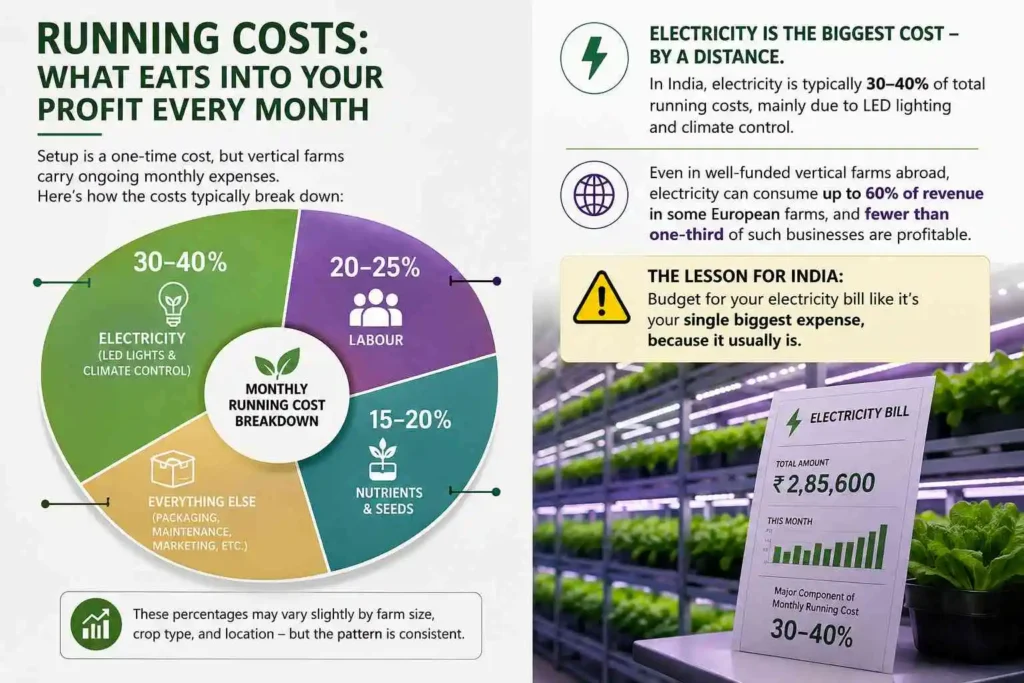
Setup is a one-time cost, but vertical farms also carry ongoing monthly expenses, and this is where new entrepreneurs often get caught out. Industry cost breakdowns show a fairly consistent pattern:
- Electricity: 30–40% of running costs (mostly LED lights and climate control)
- Labour: 20–25%
- Nutrients and seeds: 15–20%
- Everything else — packaging, maintenance, marketing: the remaining share
Electricity is, by a distance, the biggest recurring cost in vertical farming in India. It’s also the reason even large, well-funded vertical farming companies abroad have struggled to turn a profit — European industry estimates suggest electricity alone can consume up to 60% of revenue at some vertical farms, leaving fewer than a third of such businesses profitable. The lesson for anyone starting out in India: budget for your electricity bill like it’s your single biggest expense, because it usually is.
Government Schemes and Subsidy for Vertical Farming in India
Here’s the encouraging part: you don’t have to fund all of this alone. Central and state governments actively support high-tech and protected farming methods, including hydroponics and vertical systems, through several existing schemes.
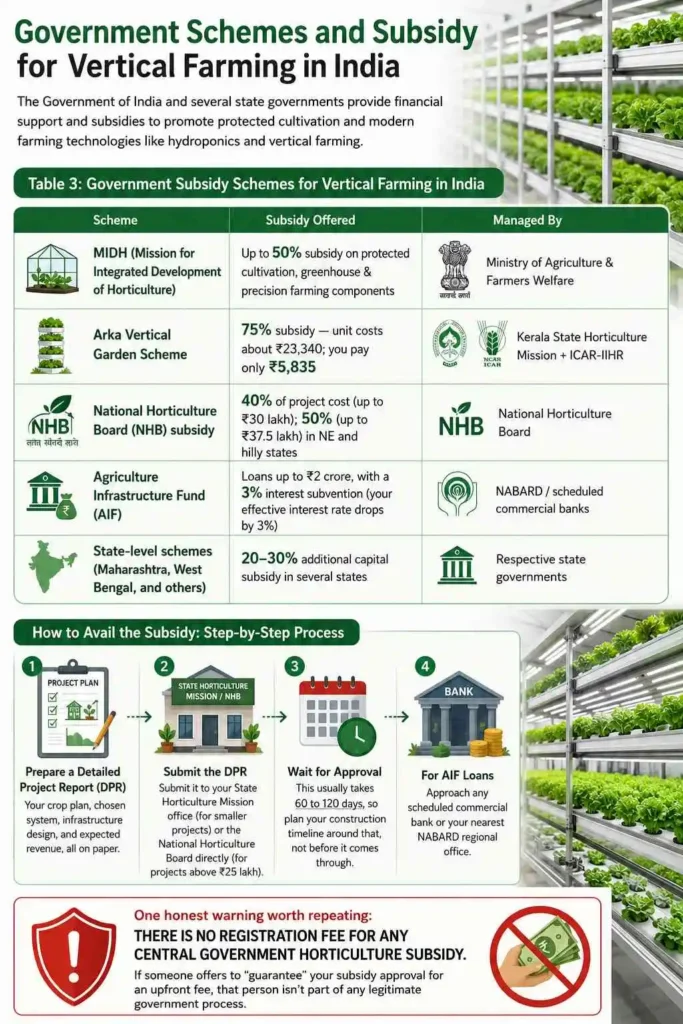
Table 3: Government Subsidy Schemes for Vertical Farming in India
| Scheme | Subsidy Offered | Managed By |
|---|---|---|
| MIDH (Mission for Integrated Development of Horticulture) | Up to 50% subsidy on protected cultivation, greenhouse & precision farming components | Ministry of Agriculture & Farmers Welfare |
| Arka Vertical Garden Scheme | 75% subsidy — unit costs about ₹23,340; you pay only ₹5,835 | Kerala State Horticulture Mission + ICAR-IIHR |
| National Horticulture Board (NHB) subsidy | 40% of project cost (up to ₹30 lakh); 50% (up to ₹37.5 lakh) in NE and hilly states | National Horticulture Board |
| Agriculture Infrastructure Fund (AIF) | Loans up to ₹2 crore, with a 3% interest subvention (your effective interest rate drops by 3%) | NABARD / scheduled commercial banks |
| State-level schemes (Maharashtra, West Bengal, and others) | 20–30% additional capital subsidy in several states | Respective state governments |
Here’s roughly how the process works, step by step:
- Prepare a Detailed Project Report (DPR) — your crop plan, chosen system, infrastructure design, and expected revenue, all on paper.
- Submit it to your State Horticulture Mission office (for smaller projects) or the National Horticulture Board directly (for projects above ₹25 lakh).
- Wait for approval — this usually takes 60 to 120 days, so plan your construction timeline around that, not before it comes through.
- For AIF loans, approach any scheduled commercial bank or your nearest NABARD regional office.
One honest warning worth repeating: there is no registration fee for any central government horticulture subsidy. If someone offers to “guarantee” your subsidy approval for an upfront fee, that person isn’t part of any legitimate government process.
Top Vertical Farming Companies in India
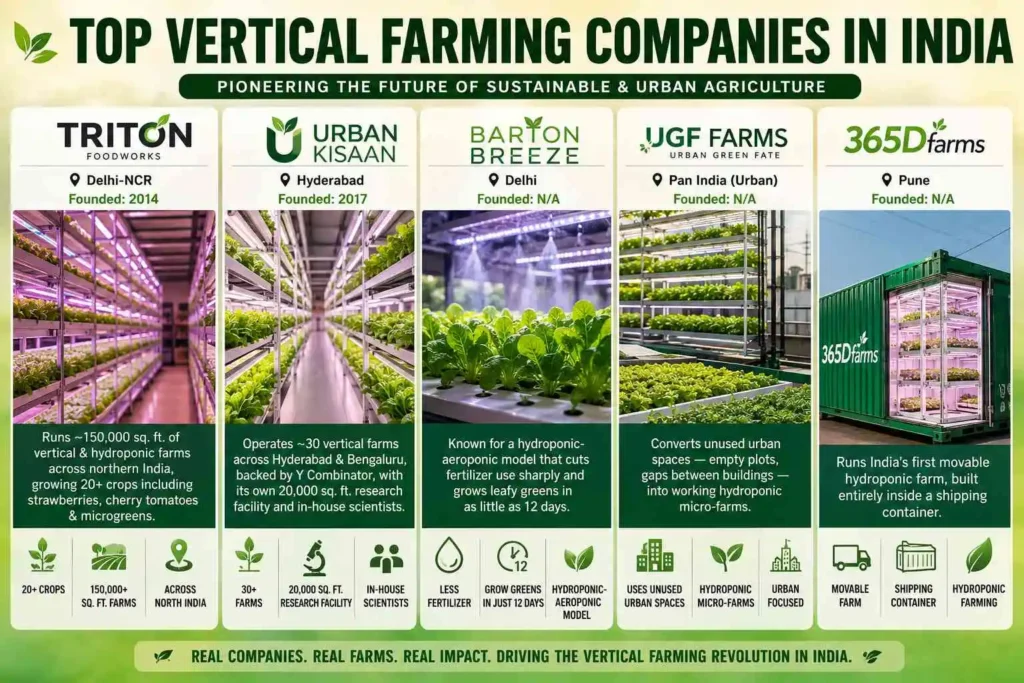
You don’t have to build every part of this from scratch. A small but real ecosystem of vertical farming companies already operates across India, and looking at how they work is a useful way to judge what’s realistic. A few worth knowing:
- Triton Foodworks (Delhi-NCR, founded 2014) – Runs roughly 150,000 sq. ft. of vertical and hydroponic farms across northern India, growing over 20 crops including strawberries, cherry tomatoes, and microgreens.
- UrbanKisaan (Hyderabad, founded 2017) – Operates around 30 vertical farms across Hyderabad and Bengaluru, backed by Y Combinator, with its own 20,000 sq. ft. research facility and in-house scientists.
- Barton Breeze (Delhi) – Known for a hydroponic-aeroponic model that cuts fertilizer use sharply and grows leafy greens in as little as 12 days.
- UGF Farms (Urban Green Fate) – Converts unused urban spaces — empty plots, gaps between buildings — into working hydroponic micro-farms.
- 365Dfarms (Pune) – Runs India’s first movable hydroponic farm, built entirely inside a shipping container.
These aren’t lab experiments. They’re functioning businesses, even though vertical farming still makes up a small slice of India’s overall agriculture sector.
Is Vertical Farming Profitable in India?
This is the question that actually matters. The honest answer: it depends, mainly on your crop choice, your access to buyers, and how tightly you control running costs.
Here’s a simple, illustrative example for a small-to-medium hydroponic leafy greens unit. These are indicative numbers, built by scaling publicly available industry cost calculations — not a promise. Your actual results will vary by city, crop, and buyer relationships.
Table 4: Illustrative Profit Calculation for a 1,000 Sq. Ft. Hydroponic Unit
| Item | Approximate Figure |
|---|---|
| Farm size | 1,000 sq. ft. |
| One-time setup cost | ₹5 lakh – ₹15 lakh |
| Running cost per crop cycle | ₹15,000 – ₹25,000 |
| Crop cycle length (leafy greens) | 25 – 35 days |
| Estimated profit per cycle | ₹1 lakh – ₹1.4 lakh |
| Crop cycles per year | 8 – 10 |
| Payback period | 18 months – 5 years |
A word of caution: some industry blogs quote eye-watering numbers, like ₹2–3 crore in annual revenue per acre for high-value crops. That’s possible only in a best-case scenario — top-quality produce, strong buyer relationships (think premium hotels or grocery chains), and a farm running near full capacity all year round. Globally, several large, well-funded vertical farming companies have downsized or shut down because electricity and labour costs quietly ate into their margins. Treat any profit projection, including the one in Table 4, as a starting point for your own calculation, not a guarantee.
Challenges of Vertical Farming in India
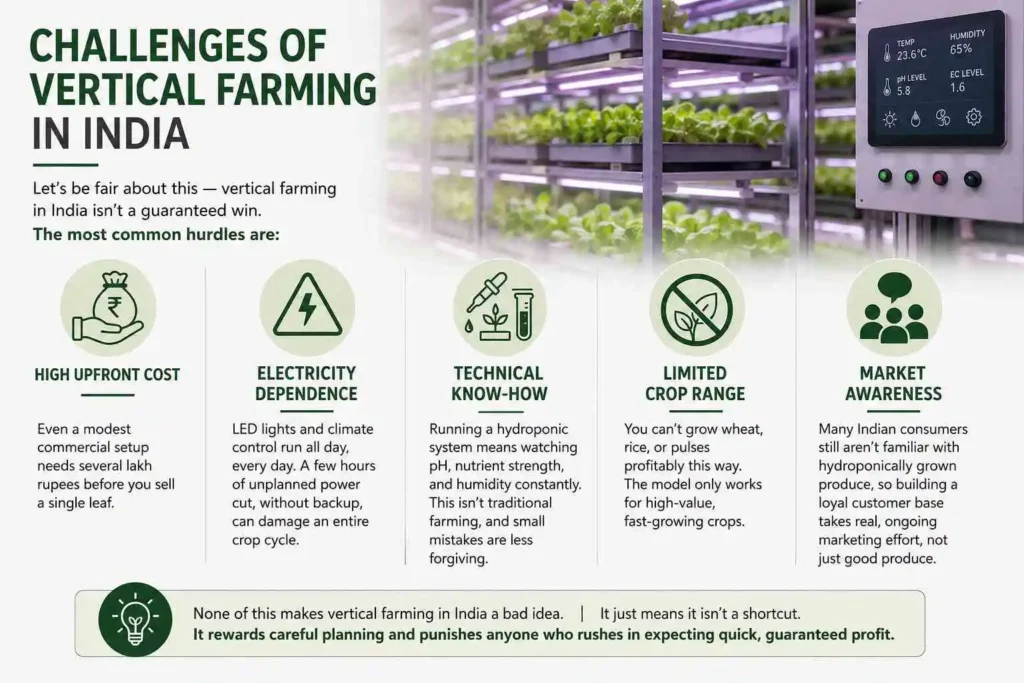
Let’s be fair about this — vertical farming in India isn’t a guaranteed win. The most common hurdles are:
- High upfront cost. Even a modest commercial setup needs several lakh rupees before you sell a single leaf.
- Electricity dependence. LED lights and climate control run all day, every day. A few hours of unplanned power cut, without backup, can damage an entire crop cycle.
- Technical know-how. Running a hydroponic system means watching pH, nutrient strength, and humidity constantly. This isn’t traditional farming, and small mistakes are less forgiving.
- Limited crop range. You can’t grow wheat, rice, or pulses profitably this way. The model only works for high-value, fast-growing crops.
- Market awareness. Many Indian consumers still aren’t familiar with hydroponically grown produce, so building a loyal customer base takes real, ongoing marketing effort, not just good produce.
None of this makes vertical farming in India a bad idea. It just means it isn’t a shortcut. It rewards careful planning and punishes anyone who rushes in expecting quick, guaranteed profit.
The Future of Vertical Farming in India
The direction ahead looks fairly clear. Subsidy schemes under MIDH and NHB continue to expand, state agricultural universities are running more hydroponics training programs — Himachal Pradesh’s agricultural university, for instance, ran one such program in 2026 under the Rashtriya Krishi Vikas Yojana — and private investment keeps flowing into Indian agri-tech.
Three things are likely to shape the next few years:
- Cheaper LED technology. Falling prices for energy-efficient grow lights should gradually lower the single biggest running cost.
- More Tier-2 city adoption. Vertical farms currently cluster around Bengaluru, Hyderabad, Delhi-NCR, and Mumbai. Expect Tier-2 cities to catch up as metro land gets pricier.
- More partnerships and buyouts. Smaller vertical farming businesses may get bought out by, or team up with, larger agri-tech companies — a pattern already common across Indian agri-tech more broadly.
Vertical farming won’t replace traditional Indian agriculture; it simply can’t grow staple grains at any meaningful scale. But as a way to bring fresh, local, pesticide-free vegetables to India’s fast-growing cities, it remains one of the more genuinely promising ideas in Indian farming today.
Quick Tips Before You Start a Vertical Farm
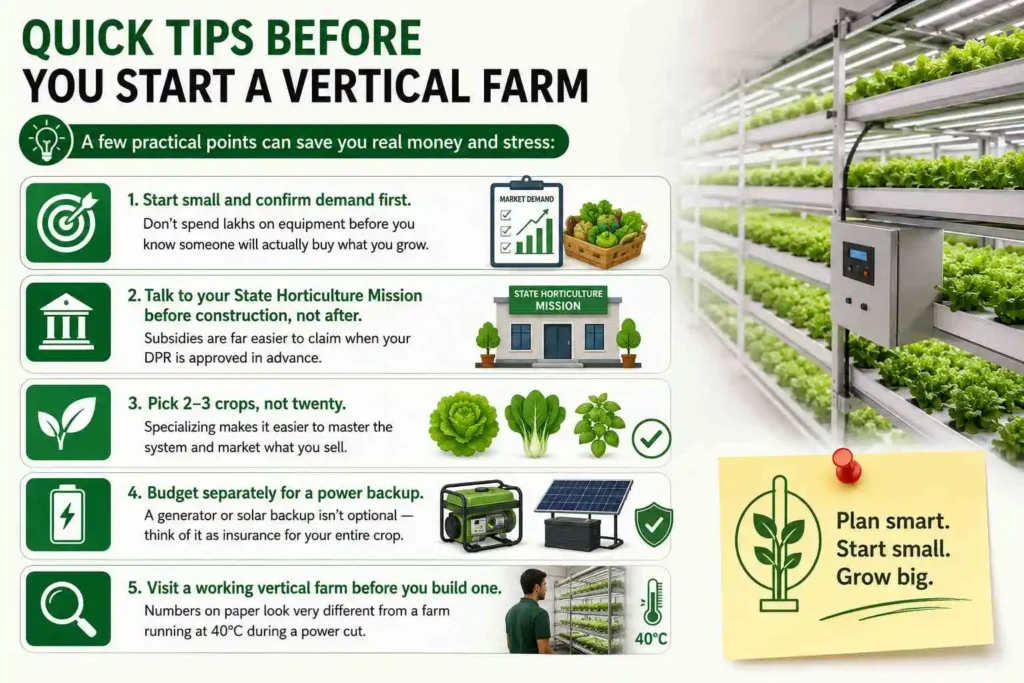
A few practical points can save you real money and stress:
- Start small and confirm demand first. Don’t spend lakhs on equipment before you know someone will actually buy what you grow.
- Talk to your State Horticulture Mission before construction, not after. Subsidies are far easier to claim when your DPR is approved in advance.
- Pick 2–3 crops, not twenty. Specializing makes it easier to master the system and market what you sell.
- Budget separately for a power backup. A generator or solar backup isn’t optional — think of it as insurance for your entire crop.
- Visit a working vertical farm before you build one. Numbers on paper look very different from a farm running at 40°C during a power cut.
Conclusion
Vertical farming in India sits at a genuinely interesting point right now. It answers real problems — shrinking farmland, falling water tables, and rising city demand for clean, local vegetables. Government schemes have made the entry cost lower than most people assume, and a growing list of Indian companies has already shown the model can work.
At the same time, it isn’t a guaranteed money-maker. It demands real capital, constant technical attention, and a genuine market for whatever you grow. Anyone seriously considering vertical farming in India should treat it like any serious business decision — with a proper cost sheet, a realistic timeline, and a clear-eyed look at both the subsidy tables and the challenges above.
Done right, it remains one of the more future-ready ways to grow food in a country that is rapidly running short on both land and water.
Vertical farming isn’t just for leafy greens. Today, farmers are also using vertical systems for aquaculture, including vertical mud crab farming, which maximizes production in a small space. Learn how it works, the setup cost, and expected profits in our Vertical Mud Crab Farming in India guide.
FAQs on Vertical Farming in India
Is vertical farming profitable in India?
It can be, particularly for high-value crops like leafy greens, herbs, and strawberries sold to urban buyers. Most commercial units report a payback period of 18 months to 5 years, though results depend heavily on crop choice and market access.
How much does it cost to start vertical farming in India?
Costs range from under ₹1 lakh for a small home setup to over ₹1 crore for a fully automated, one-acre commercial farm. A mid-size commercial unit typically needs ₹15 lakh to ₹50 lakh.
Does the Indian government give subsidy for vertical farming?
Yes. While there’s no scheme labelled purely “vertical farming subsidy,” entrepreneurs can access subsidies of 40–75% through MIDH, the National Horticulture Board, and state horticulture missions, plus low-interest loans through the Agriculture Infrastructure Fund.
What crops are best for vertical farming in India?
Fast-growing, high-value crops work best: lettuce, spinach, kale, microgreens, basil, mint, coriander, strawberries, cherry tomatoes, and bell peppers. Staple grains like wheat and rice aren’t suitable.
Is vertical farming better than traditional farming?
Not exactly “better” — it’s different. Vertical farming uses far less water and land and works year-round regardless of season, but it needs much higher upfront investment and doesn’t suit staple crops. It’s best seen as a complement to traditional farming, not a replacement for it.
Newsletter